TO SAVE, SAVING, SAVED
regaining control over our attention in the information age
year
2024
field
Information Design
Design Research
Editorial Design
nature
INDIVIDUAL
FINAL YEAR PROJECT
In the Age of Information, the proliferation of communication tools and media has transformed the information landscape. Digital media and technological breakthroughs have made information more accessible, while giving rise to the attention economy, where companies compete and profit by capturing our attention.
Hence, To Save, Saving, Saved aims to spark reflections on information consumption and highlight the need to regain control over our attention.
In the Age of Information, the proliferation of communication tools and media has transformed the information landscape. Digital media and technological breakthroughs have made information more accessible, while giving rise to the attention economy, where companies compete and profit by capturing our attention.
Hence, To Save, Saving, Saved aims to spark reflections on information consumption and highlight the need to regain control over our attention.
In the Age of Information, the proliferation of communication tools and media has transformed the information landscape. Digital media and technological breakthroughs have made information more accessible, while giving rise to the attention economy, where companies compete and profit by capturing our attention.
Hence, To Save, Saving, Saved aims to spark reflections on information consumption and highlight the need to regain control over our attention.
In the Age of Information, the proliferation of communication tools and media has transformed the information landscape. Digital media and technological breakthroughs have made information more accessible, while giving rise to the attention economy, where companies compete and profit by capturing our attention.
Hence, To Save, Saving, Saved aims to spark reflections on information consumption and highlight the need to regain control over our attention.
(i) TO SAVE
(i) TO SAVE
(i) TO SAVE
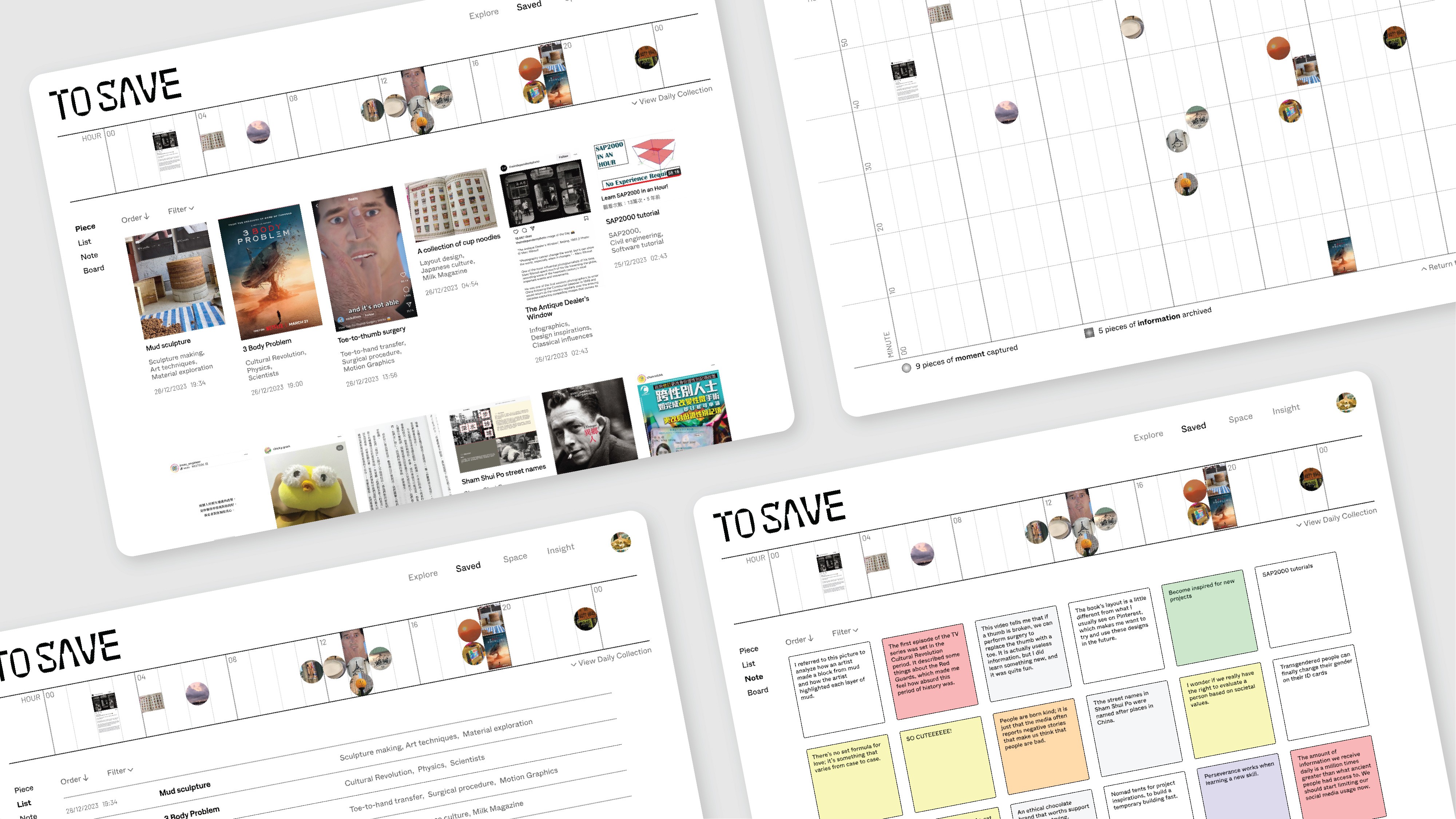
TO SAVE is an online archiving platform with a mobile plugin that introduces an alternative information consumption experience. It encourages users to preserve and share meaningful content.


(ii) SAVING
(ii) SAVING
(ii) SAVING
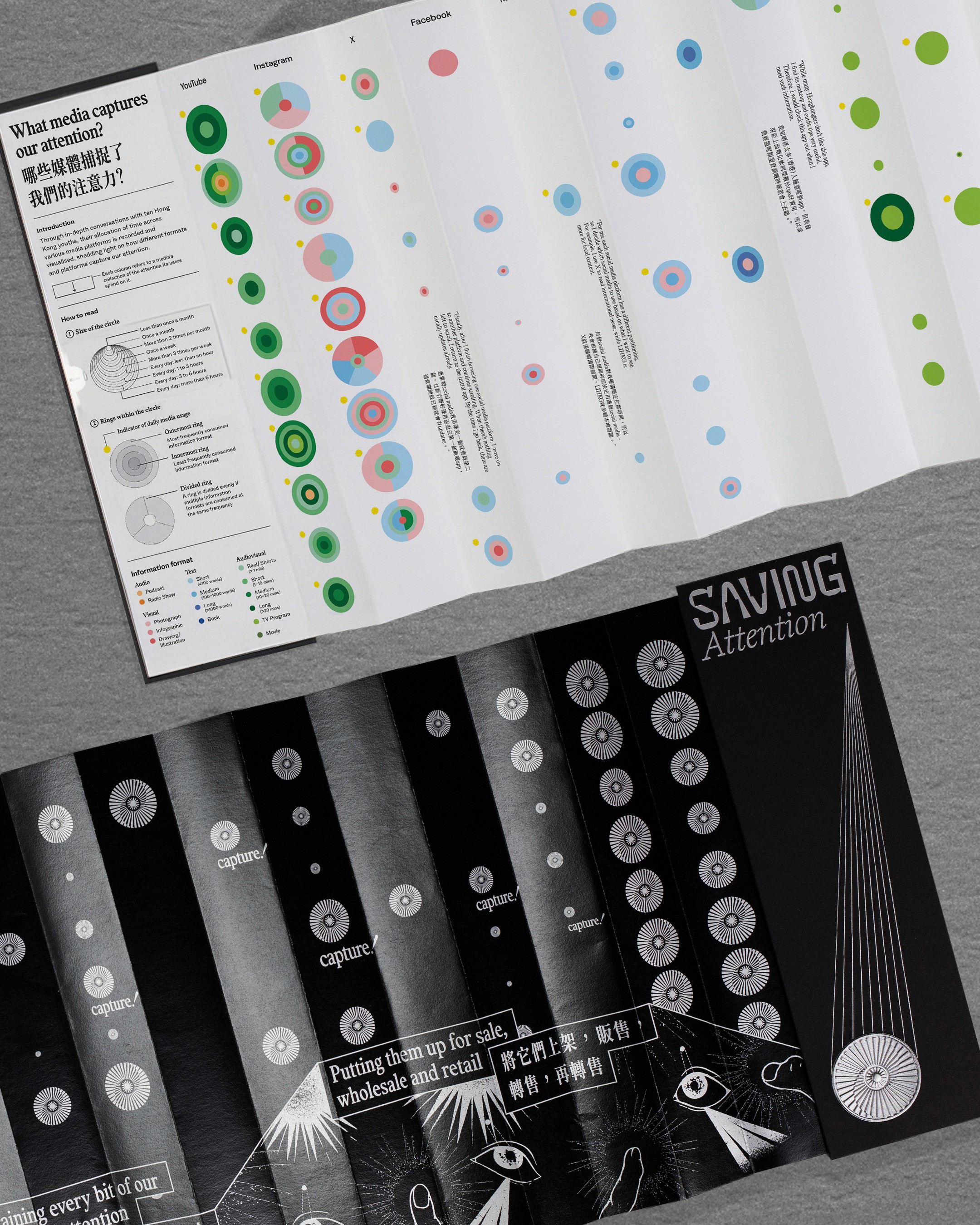
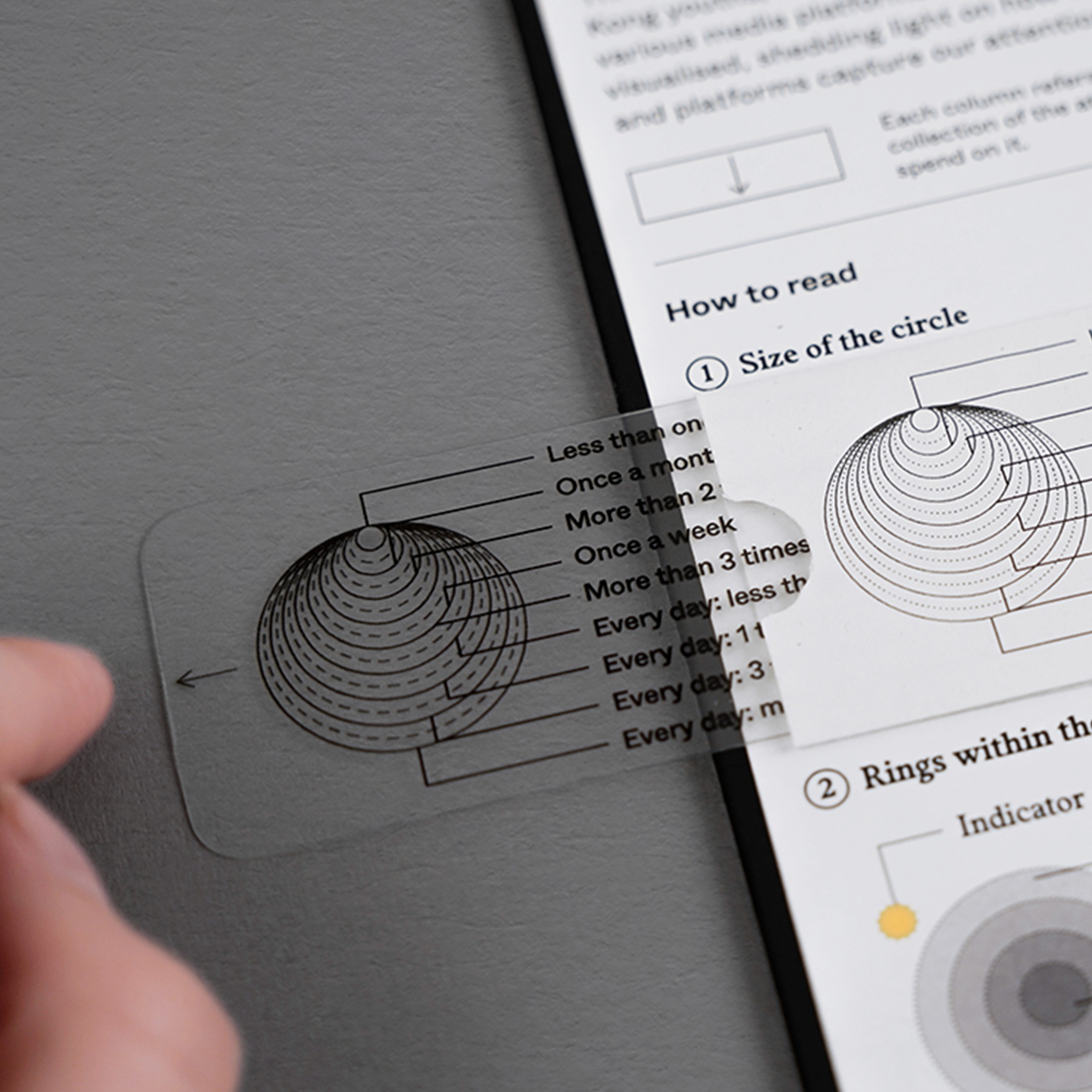
SAVING Attention stems from in-depth conversations with ten Hong Kong youths, focusing on their media usage habits and time allocation across different platforms.
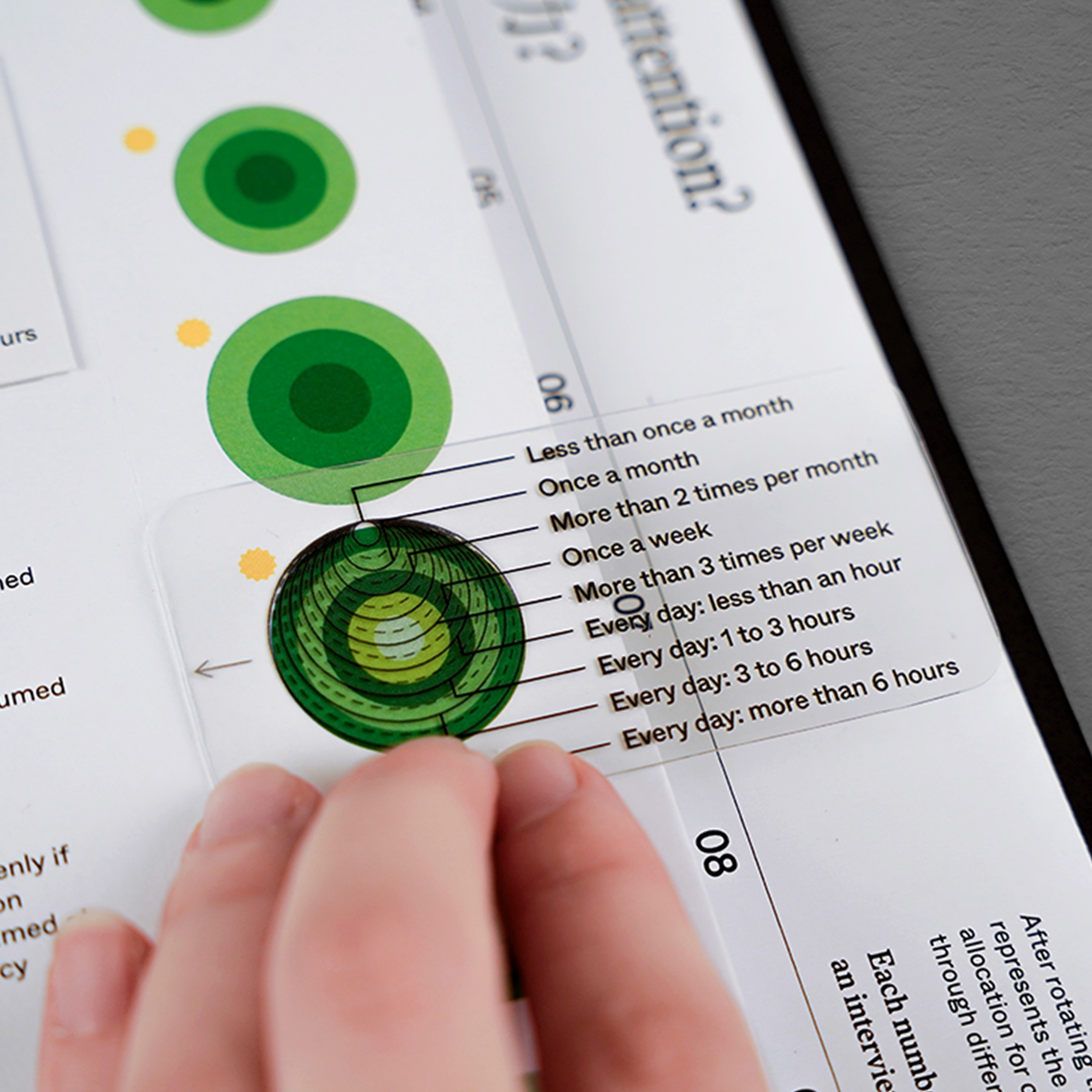
The publication presents an infographic where each circle indicates the users’ time spent on a specific medium, with larger circles denoting more frequent use, while distinct colours represent various media formats.
Inspired by Tobias Rose-Stockwell's insight that engagement is the currency of the attention economy, the B-side features a graphic poster illustrating how media captures attention for profit. The front cover symbolises this concept with a coin, representing "attention as currency."
SAVING Attention stems from in-depth conversations with ten Hong Kong youths, focusing on their media usage habits and time allocation across different platforms.
The publication presents an infographic where each circle indicates the users’ time spent on a specific medium, with larger circles denoting more frequent use, while distinct colours represent various media formats.
Inspired by Tobias Rose-Stockwell's insight that engagement is the currency of the attention economy, the B-side features a graphic poster illustrating how media captures attention for profit. The front cover symbolises this concept with a coin, representing "attention as currency."
SAVING Attention stems from in-depth conversations with ten Hong Kong youths, focusing on their media usage habits and time allocation across different platforms.
The publication presents an infographic where each circle indicates the users’ time spent on a specific medium, with larger circles denoting more frequent use, while distinct colours represent various media formats.
Inspired by Tobias Rose-Stockwell's insight that engagement is the currency of the attention economy, the B-side features a graphic poster illustrating how media captures attention for profit. The front cover symbolises this concept with a coin, representing "attention as currency."
SAVING Attention stems from in-depth conversations with ten Hong Kong youths, focusing on their media usage habits and time allocation across different platforms.
The publication presents an infographic where each circle indicates the users’ time spent on a specific medium, with larger circles denoting more frequent use, while distinct colours represent various media formats.
Inspired by Tobias Rose-Stockwell's insight that engagement is the currency of the attention economy, the B-side features a graphic poster illustrating how media captures attention for profit. The front cover symbolises this concept with a coin, representing "attention as currency."





(iii) SAVED
(iii) SAVED
(iii) SAVED
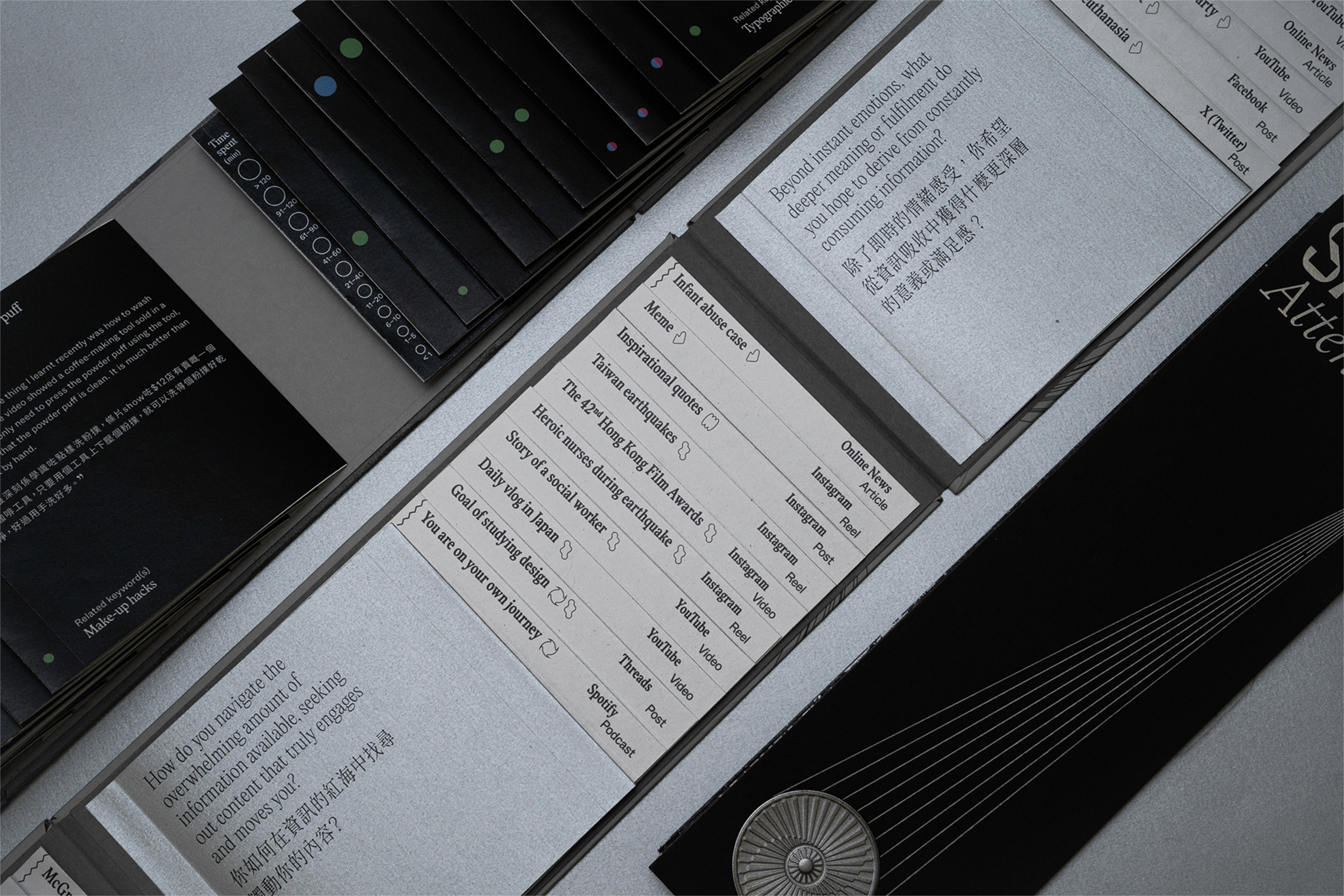
SAVED Emotions and SAVED Thoughts stem from conversations with fifty youths in Hong Kong, starting with the question “What specific information has deeply resonated with your emotions/ provoked profound thoughts within you, leaving a lasting impact?”.
The publication series then conceals 50 pieces of both emotion-evoking information and thought-provoking information encountered by these people.
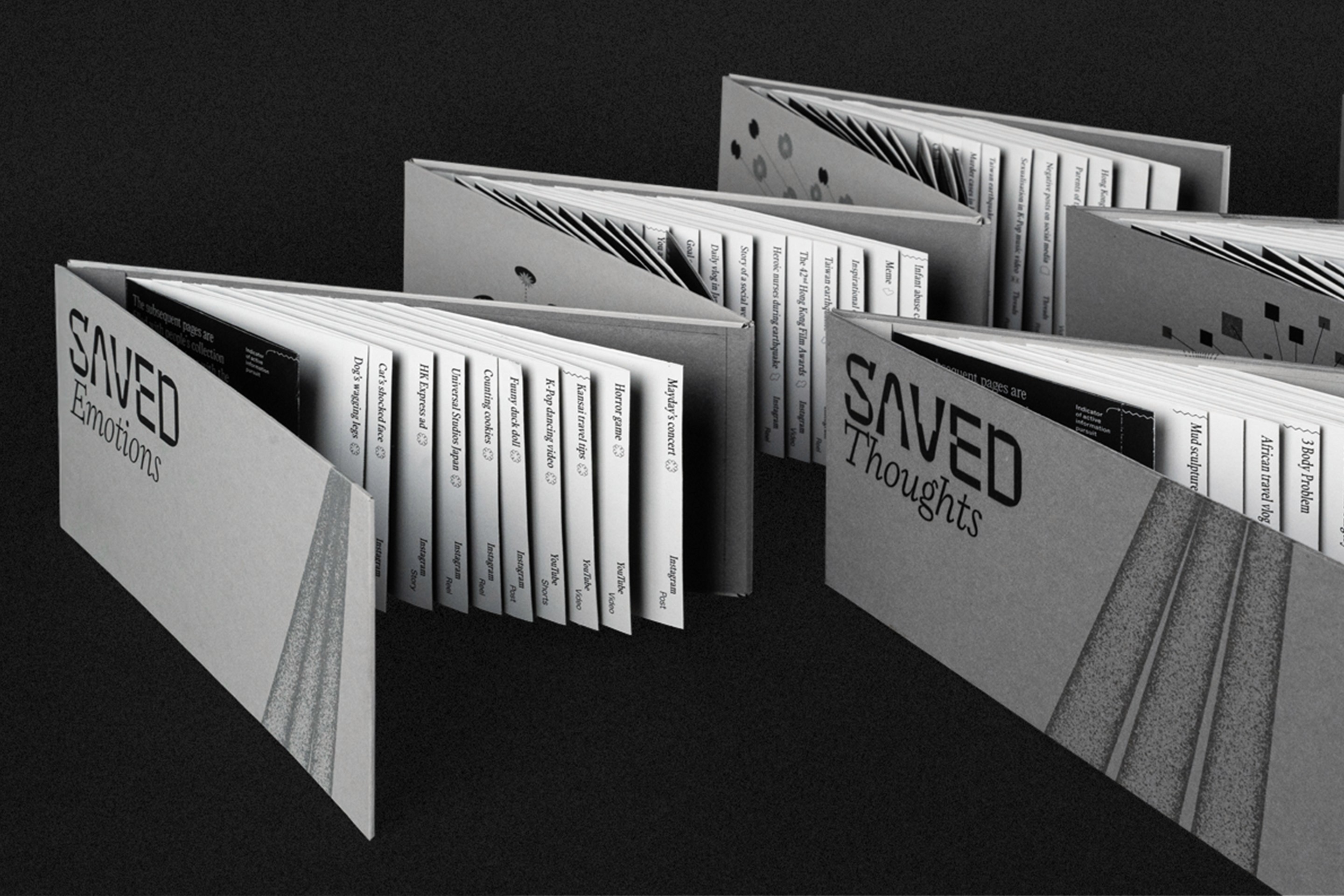
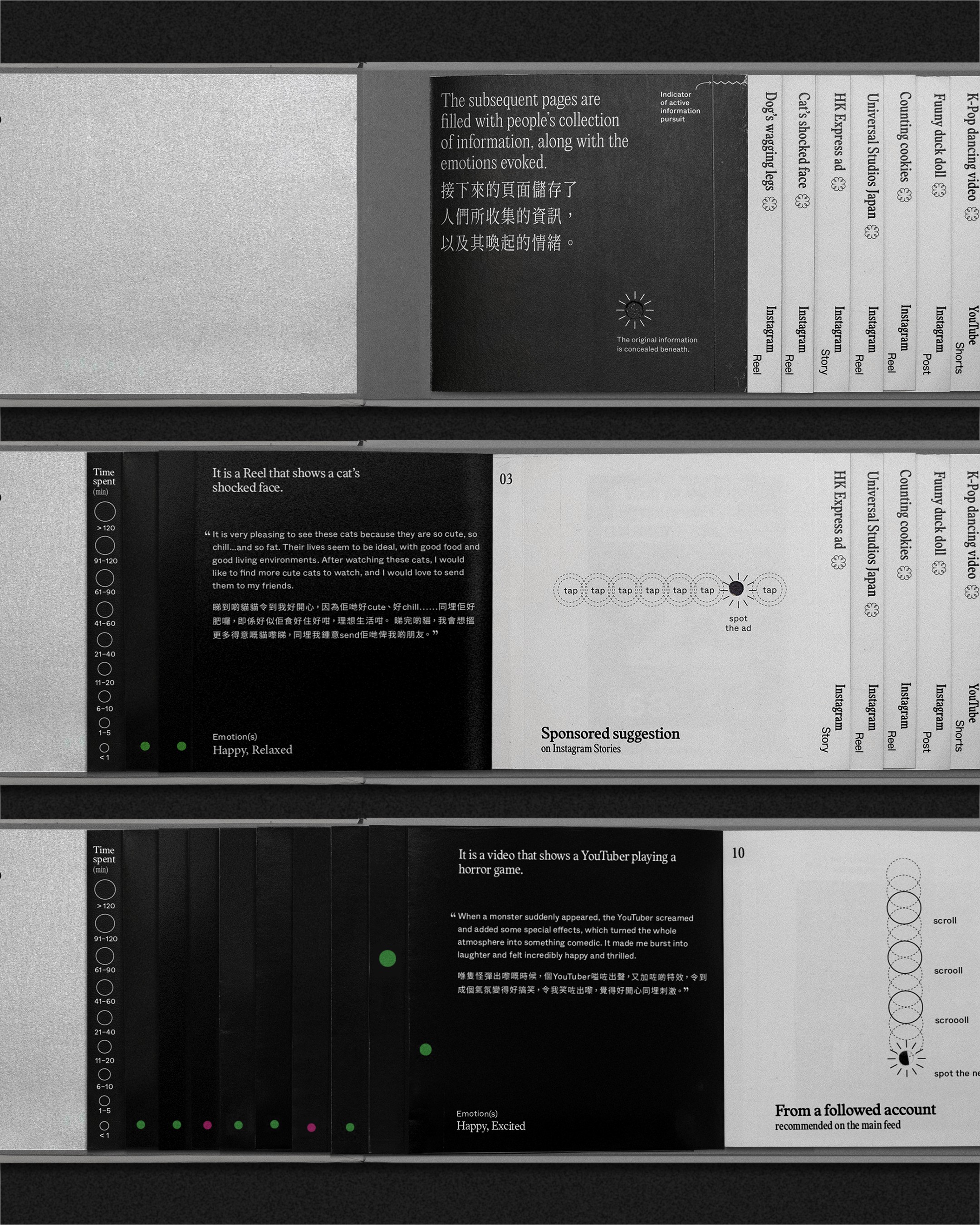
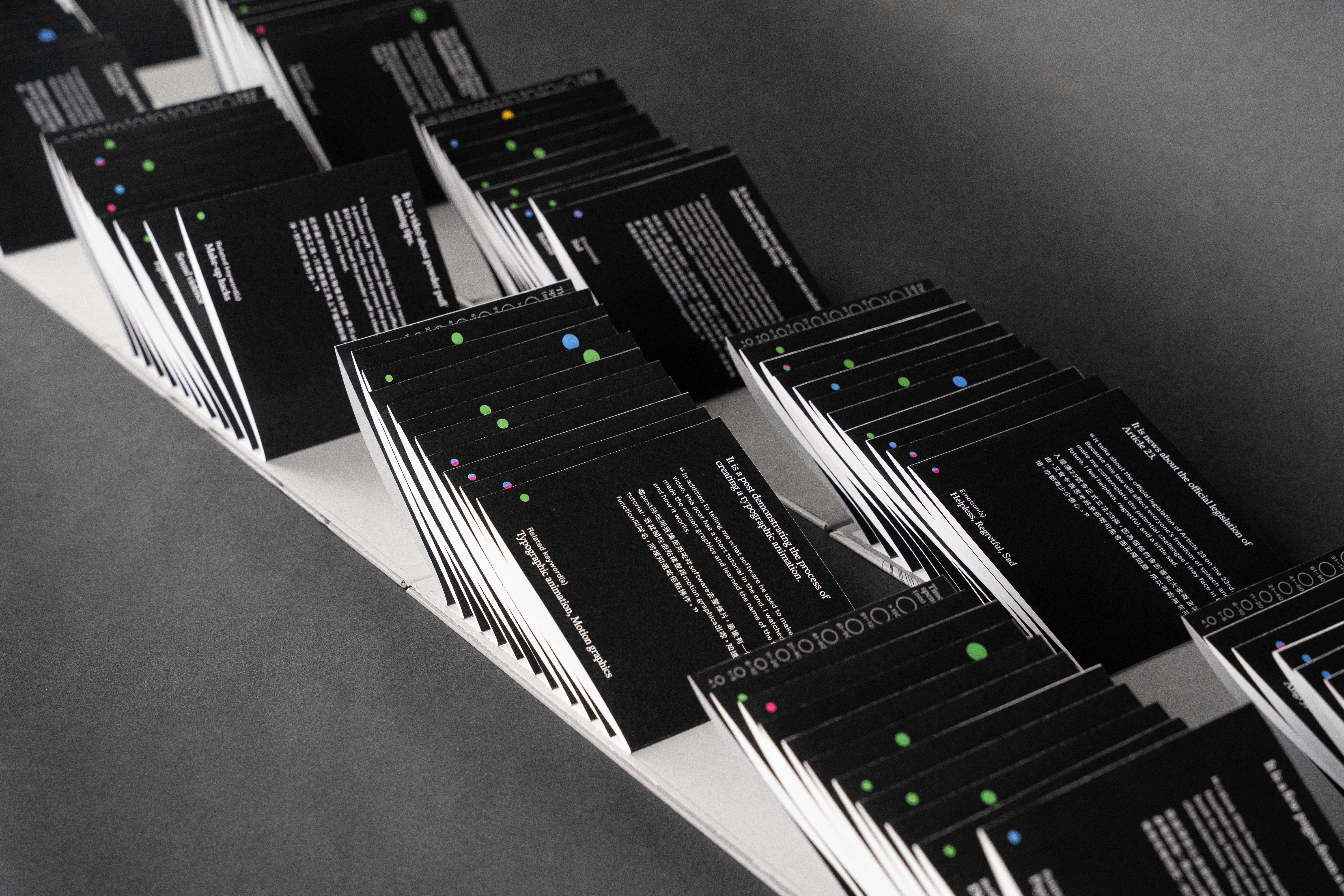
The dragon-scale binding allows readers to get an overview of the different information. Then, readers can look at how others discovered the information, peek at the original content, and understand its lasting impact, along with infographics of the time spent on each piece of information.
SAVED Emotions and SAVED Thoughts stem from conversations with fifty youths in Hong Kong, starting with the question “What specific information has deeply resonated with your emotions/ provoked profound thoughts within you, leaving a lasting impact?”.
The publication series then conceals 50 pieces of both emotion-evoking information and thought-provoking information encountered by these people.
The dragon-scale binding allows readers to get an overview of the different information. Then, readers can look at how others discovered the information, peek at the original content, and understand its lasting impact, along with infographics of the time spent on each piece of information.
SAVED Emotions and SAVED Thoughts stem from conversations with fifty youths in Hong Kong, starting with the question “What specific information has deeply resonated with your emotions/ provoked profound thoughts within you, leaving a lasting impact?”.
The publication series then conceals 50 pieces of both emotion-evoking information and thought-provoking information encountered by these people.
The dragon-scale binding allows readers to get an overview of the different information. Then, readers can look at how others discovered the information, peek at the original content, and understand its lasting impact, along with infographics of the time spent on each piece of information.
SAVED Emotions and SAVED Thoughts stem from conversations with fifty youths in Hong Kong, starting with the question “What specific information has deeply resonated with your emotions/ provoked profound thoughts within you, leaving a lasting impact?”.
The publication series then conceals 50 pieces of both emotion-evoking information and thought-provoking information encountered by these people.
The dragon-scale binding allows readers to get an overview of the different information. Then, readers can look at how others discovered the information, peek at the original content, and understand its lasting impact, along with infographics of the time spent on each piece of information.


